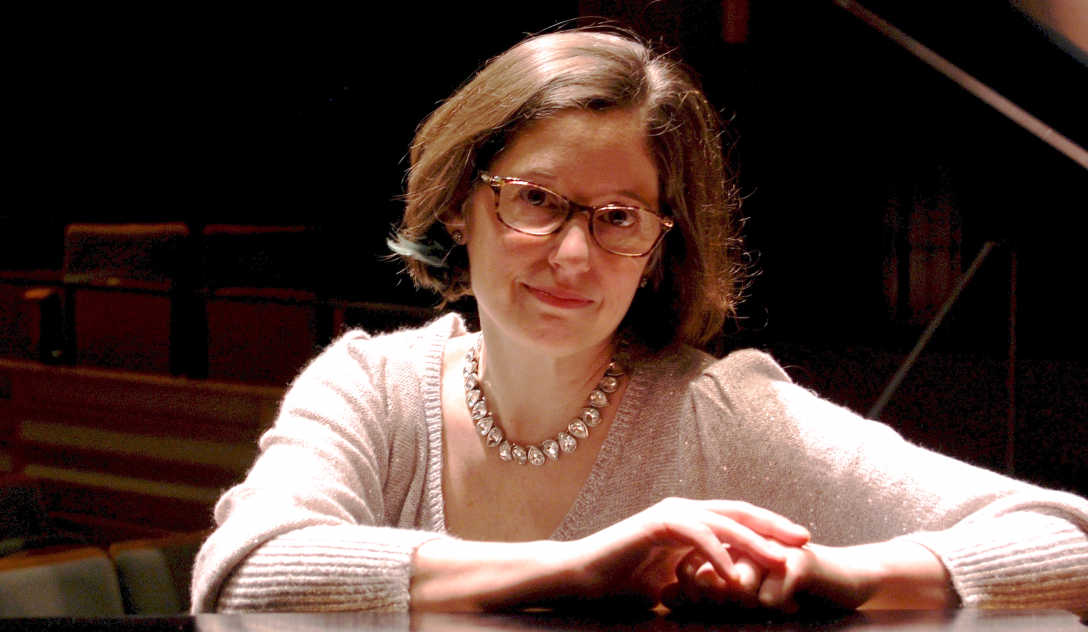
Link to the concert livestream
A few brief notes on the program, with some links for further reading:
Libby Larsen’s “Margaret Songs”(1996) are excerpted from her chamber opera Eric Hermannson’s Soul, based on a short story by Willa Cather. In the story, the protagonist Margaret Eliot travels from New York City to the plains of Nebraska. Leaving her high society Victorian life behind, she discovers love and a new way of life. Cather and Larsen’s combined language captures the wide open spaces and plain speaking of the American Midwest in a way that appeals to both performers, Coleman being a native of Kansas City, and Kissel having spent much of her childhood in Manhattan, Kansas.
Ivor Gurney was both a poet and composer from Gloucester, England who served in the British army in World War I. His musical studies at the Royal Academy of Music in London were interrupted by his stint in the war. From the trenches in 1917, he published his first volume of poetry, Severn and Somme, which (to quote the book’s preface) was “written in France, and in sound of the guns.” Primarily known as a composer of songs, the Elizabethan Songs on today’s program were his first published musical work, printed in 1920 as he was completing his studies of composition under the tutelage of Vaughan Williams. The Elizabethan poems he assembled for these songs betray his literary sensibilities—“Orpheus” and “Under the Greenwood Tree” from William Shakespeare, “Sleep” from John Fletcher and “Spring” by Thomas Nashe.
Mirabai Rathor, a princess from northwest India during the sixteenth century, bucked the conventions of her age. She objected to her arranged marriage, and upon her husband’s death, refused to commit the expected act of sati (self-immolation on the husband’s funeral pyre). She was an ardent devotee of the Hindu god Krishna, and a follower of the bhakti movement, which is characterized by an intense, personal, and emotional relationship with the deity. Mirabai’s poetry was translated into English by American poet Robert Bly, and six of these poems were selected by American composer John Harbison for his Mirabai Songs (1983).
Bly’s translations of Mirabai’s poems can be found here:
It’s true I went to the market
Why Mira Can’t Go Back to Her Old House
Mary Kissel’s poem “Night Watch” first appeared in Touchstones literary magazine in 1982. It was set to music by composer Caroline Mallonée in 2020 with support from the Kissel family and friends from Kissel’s days in the English department at Kansas State University. Read more about the “Night Watch” premiere on pianist Anne Kissel’s blog. The full text of the poem is below.
They are all restless
tonight. My husband’s legs
quiver in his dream, his breath
a pause I touch. He sighs
and turns. I listen.
From other rooms
a flung arm,
low cry, soft creak
of blankets rising and falling.
I wait while feet scrape the carpet
to my bed. My daughter
can’t sleep. I reach out
and pull her in. She molds herself
to my body and finds instant sleep
against my shoulder.
I lie awake, listening
to the tick of the house, the furnace
turning off and on. I touch
my husband’s leg with my leg
and smell my daughter’s hair.
I listen hard. The whole house
listens as dark shapes move
and meet and dissipate. I watch
the darkness like my mother,
like the dinosaur, like the first
mother who ever lived.
The two final songs on the program by American composer Jake Heggie are taken from his song cycle Newer Every Day: Songs for Kiri. The songs set poems by Emily Dickinson, and received their premiere at the Ravinia Festival in 2014 to commemorate the 70th birthday of acclaimed soprano Kiri Te Kanawa. The poems can be found here:
Goodnight (actually a mash-up of two poems, which you’ll find here and here)

 Collabscribbles