Night Watch notes

Link to the concert livestream

Link to the concert program

A few brief notes on the program, with some links for further reading:

Libby Larsen’sMargaret Songs”(1996) are excerpted from her chamber opera Eric Hermannson’s Soul, based on a short story by Willa Cather. In the story, the protagonist Margaret Eliot travels from New York City to the plains of Nebraska. Leaving her high society Victorian life behind, she discovers love and a new way of life. Cather and Larsen’s combined language captures the wide open spaces and plain speaking of the American Midwest in a way that appeals to both performers, Coleman being a native of Kansas City, and Kissel having spent much of her childhood in Manhattan, Kansas.

Ivor Gurney was both a poet and composer from Gloucester, England who served in the British army in World War I. His musical studies at the Royal Academy of Music in London were interrupted by his stint in the war. From the trenches in 1917, he published his first volume of poetry, Severn and Somme, which (to quote the book’s preface) was “written in France, and in sound of the guns.” Primarily known as a composer of songs, the Elizabethan Songs on today’s program were his first published musical work, printed in 1920 as he was completing his studies of composition under the tutelage of Vaughan Williams. The Elizabethan poems he assembled for these songs betray his literary sensibilities—“Orpheus” and “Under the Greenwood Tree” from William Shakespeare, “Sleep” from John Fletcher and “Spring” by Thomas Nashe.

Mirabai Rathor, a princess from northwest India during the sixteenth century, bucked the conventions of her age. She objected to her arranged marriage, and upon her husband’s death, refused to commit the expected act of sati (self-immolation on the husband’s funeral pyre). She was an ardent devotee of the Hindu god Krishna, and a follower of the bhakti movement, which is characterized by an intense, personal, and emotional relationship with the deity. Mirabai’s poetry was translated into English by American poet Robert Bly, and six of these poems were selected by American composer John Harbison for his Mirabai Songs (1983).

Bly’s translations of Mirabai’s poems can be found here:

It’s true I went to the market

All I was Doing was Breathing

Why Mira Can’t Go Back to Her Old House

Where Did You Go?

The Clouds

Don’t Go, Don’t Go

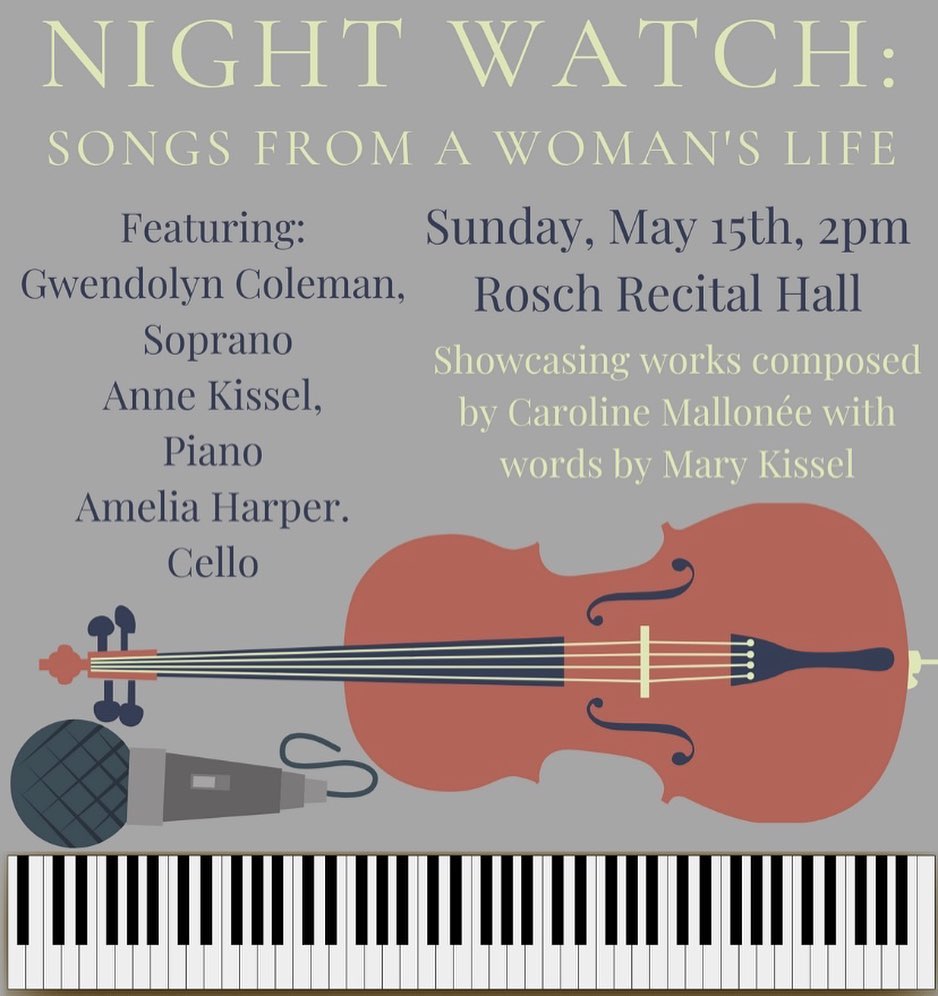
Mary Kissel’s poem “Night Watch” first appeared in Touchstones literary magazine in 1982. It was set to music by composer Caroline Mallonée in 2020 with support from the Kissel family and friends from Kissel’s days in the English department at Kansas State University. Read more about the “Night Watch” premiere on pianist Anne Kissel’s blog. The full text of the poem is below.

They are all restless

tonight. My husband’s legs

quiver in his dream, his breath

a pause I touch. He sighs

and turns. I listen.

From other rooms

a flung arm,

low cry, soft creak

of blankets rising and falling.

I wait while feet scrape the carpet

to my bed. My daughter

can’t sleep. I reach out

and pull her in. She molds herself

to my body and finds instant sleep

against my shoulder.

I lie awake, listening

to the tick of the house, the furnace

turning off and on. I touch

my husband’s leg with my leg

and smell my daughter’s hair.

I listen hard. The whole house

listens as dark shapes move

and meet and dissipate. I watch

the darkness like my mother,

like the dinosaur, like the first

mother who ever lived.

The two final songs on the program by American composer Jake Heggie are taken from his song cycle Newer Every Day: Songs for Kiri. The songs set poems by Emily Dickinson, and received their premiere at the Ravinia Festival in 2014 to commemorate the 70th birthday of acclaimed soprano Kiri Te Kanawa. The poems can be found here:

That I did always love

Goodnight (actually a mash-up of two poems, which you’ll find here and here)
Music and the Personal: some musings on an upcoming premiere

In a speech at the Aspen Festival in 1964, composer Benjamin Britten said of his music “I believe in roots, in associations, in backgrounds, in personal relationships.” This statement has always been meaningful to me. My own musical impulses are grounded in the same belief; the most memorable and best musical moments of my life have been ones with deep connection to people I love; my greatest musical collaborations have been ones forged alongside friendship.

There is no musical expression more intimate than a song. My love of songs has always been intertwined with my appreciation of poetry, learned from my mother, also a lover and writer of words. During my childhood, my mother pursued graduate work in the English department of Kansas State University, where she subsequently taught, and she wrote a fair bit of poetry during those years.  I’ve long wanted to commission a musical setting of her work, and I finally decided to pursue the idea in earnest towards the end of 2019.

I chose a poem entitled “Night Watch,” which describes a moment of lying awake at night, listening with some unease to the sounds of the house, while comforting a sleepless child (me!). The poem is attractive to me on a number of levels—its description of silence and the most subtle sounds of night, and the feelings of anxiety that they evoke, and the family connections contained within it (my own child self, my father, and my grandmother are all present in the poem).

In 2020, I approached Buffalo-based composer Caroline Mallonee about setting the poem for soprano, piano, and cello, as I wanted my own daughter, a budding cellist, to be a part of the project. Mallonee’s music beautifully captures both the lightness and darkness of the poem: tango-like gestures describe the act of a mother pulling her restless child into an embrace, the harmonics of the cello depict the sound of a furnace turning off and on, and a sudden turn to the warmth of D-flat major evokes the depth of feeling between mother and child. Yet restlessness pervades the musical texture, erupting towards the end in a moment of anxiety “as dark shapes move and meet and dissipate.”

It has been ten years since my last recital with my dear friend, the soprano Gwen Coleman. There is much to admire in Gwen’s artistry. What I love most about Gwen’s singing is the tremendous care she takes with words, the way she measures them, tastes the music in them, and imbues them with meaning. The roots of our friendship are in our shared experience as mothers of young children nearly 20 years ago, and I’m forever grateful to her for the kindness she extended to me as I learned to find my footing as a musician while settling into my new role as a mother. For all of these reasons, she has been the perfect collaborator for this project.

I’m grateful for the support of my mother’s circle of friends from her days in the English department at Kansas State University. I remember their lively meetings in my home as a child, when they would meet to discuss books and politics late into the night. A core group of them have remained in touch, and they have provided financial support for this commission. This connection adds another layer of meaning; it is a tangible reminder of the relationships that lift us, that buoy us through moments of challenge.

The larger impulse behind the project is ultimately the desire to be engaged in creative work that speaks to my own life experience, that is rooted in the relationships most dear to me. I love that it feels lifted by a web of women across generations—my grandmother, the voice of my mother as a young woman, her dear friends, a dear friend of my own, and my daughter.  

I’m grateful to my daughter, Amelia, for engaging with this piece in spite of the difficulties presented by the fact that she is now in college many miles away, pursuing serious study in the sciences. There are no words to describe the joy I feel communicating with her through music. I’m doubly grateful that my mother can be present to hear it.

#NowIsTheTime

In a meeting last week, one of my teaching colleagues posed the question: should we begin talking to students and prospective students about the future of careers in music in the post-covid world? I could feel the anguish in his question. With most live performances cancelled for the foreseeable future, our friends, colleagues, and former students whose livelihoods depend on the stage are hurting. We have to acknowledge that this question is on the minds of every young aspiring musician– is there still a life to be made here?

The answer for me unfolds like this: there is tremendous need in the world right now for music, in so many ways. For “front line musicians”– teachers of children, leaders of community music, and music therapists, the amount of work to be done is colossal. We’ll need an army of music educators to tend to the intellectual, creative, and emotional needs of children whose growth has been stunted during the pandemic. A curriculum rich in music will help inspire, heal, and motivate young learners when our schools are fully back in session. Music therapists, and community choruses, bands, and orchestras will have their work cut out for them, as people from all walks of life with all sorts of challenges turn to music for emotional, mental, and even physical healing.

For performers, the question is more difficult. Regional orchestras, opera companies, and concert series will inevitably shut their doors like so many other businesses. In the short term, there will be fewer good jobs, and fewer gigs to go around. But I do know this: so many people are starving for live music. For myself, I know that whenever I’m able to attend a live opera again, I’ll be stowing a full box of kleenex and sunglasses in my purse. When concert halls and theaters re-open their doors, there will be huge demand for seats. I’ll be there. Won’t you?

Performers need to be ready to rise and meet that need. We will need new ensembles, new companies, new presenters who are prepared to make art in new ways, serve new audiences. It will take time and it will take financial support, but there is going to come a time when we see artistic rebirth happening in all kinds of ways and in all kinds of places.

Back to my meeting. Another colleague coined this perfect catch phrase for the moment we are in: Now is the time. For young aspiring musicians, the time is now to take a deep dive into those Kapustin preludes, those Bach fugues. Read. Write daily about the artistic life you envision. Practice, perfect your craft on your instrument. Learn a language. Research composers whose music may be less-known but may speak deeply to you. Connect with like-minded musicians and scheme about future collaborative projects. Let your ideas begin to percolate.

If you are just on your way to college, don’t be afraid to major in music. If attending an expensive conservatory seems too risky in the current climate, perhaps you work on a double major in a liberal arts setting, or you pursue music education at an institution that also allows you to delve into performance. Choose a college that fosters entrepreneurship in the arts, and use your four years to begin imagining the creative landscape you’d like to build. (By the way, Fredonia is a place where you could do all of these things).

Don’t be afraid! The world needs music now more than ever, and if music is pulling on your heart, listen. Now is the time.

Emerging from Quarantine

Mid-March hit, like a ton of bricks. Like many people, my priorities shifted overnight. The first few weeks were absorbed with creating online teaching content, reaching out to students who were AWOL, and hatching a game plan to tend to the needs of my two children, ages eight and sixteen. There was no time and certainly no energy to practice the piano, or think about my blog, or nudge along any of the handful of creative projects I’ve had simmering on back burners.

As the weeks marched along, I found it hard to look at the Steinway in my living room without a deepening sense of despair. So many activities need to take place in that room—my own teaching, my son’s piano lessons, my daughter’s cello practice. The quiet state of mind required to practice felt entirely out of reach. I was saved, somewhat, by my daughter’s desire to devote her extra free time to her cello, which meant she required my services as her pianist. We started work together on her first Beethoven sonata, the A major. It is hard to think of a piece of music more straightforwardly joyful. It buoyed me, as did the astonishment I increasingly felt as I communicated in music with my own child. Her artistry seems to fit me like a glove; our communication easy, clear, uncluttered, full of mutual love and understanding. This is astonishing in part because outside of music, my daughter is prickly, serious, terse in her communication, and refuses to engage in conversation that is not essential (the question “how was your day?” can send her into hysterics. Ask her a smart question about politics or quantum mechanics and she will talk your ear off).

The Beethoven sonata with my daughter led me to my bookshelf, where I found Schubert and Mozart. Solo repertoire, which I haven’t played in years, seems to capture the solitary feeling of this moment. It is allowing me to dip my toes in some music without confronting the looming questions: what is collaboration really, and how do we nurture it, practice it, teach it in a time when we cannot share close physical proximity? Combining separately recorded tracks, or working in separate spaces might facilitate some individual music making, but is this really collaborating? Collaboration is about exchange of energy. It is trust, openness, generosity, empathy. When we make music together, where is the music exactly? It emanates from a singer’s body, and from a pianist’s own in connection to their instrument. Do our musics intertwine, do they dance together? Where is the listener in this dance?

Many of my former students have reached out to me in the past few months. They have expressed worry about their livelihoods, both short-term financial worries, and also anxiety that their work as musical collaborators will be replaced in the long-term by recorded tracks. I feel confident as I assure them that no one will enjoy rehearsing with a machine, and the experience will only draw attention to all the ways that live collaboration with a skilled pianist is better. I am convinced that our musical partners will be overjoyed to return to our studios and practice rooms once the pandemic is over. We just have to find ways to sustain ourselves until then.

To Be Read in Winter: program notes for Schubert song cycles

“To be read in Winter” (Im Winter zu lesen) is inscribed at the beginning of Wilhelm Müller’s collection of poetry published in 1824 under the colorful title “Poems from the Posthumous Papers of a Travelling Horn Player” (Gedichte aus den hinterlassenen Papeieren eines reisenden Waldhornisten). The poems that comprise Schubert’s two epic song cycles Die schöne Müllerin and Winterreise can be found in this anthology, and as the poet commands, we open the book on these poems in a snowy February, with some distance from the romantic, idealistic nineteenth century in which they were created. Both cycles deal with the journey of solitary protagonists, two romantic heroes who have been disappointed by love and grapple, each in their own way, with a world that cannot contain their ideals and their dreams. The miller of the first cycle is the consummate dreamer. Searching for purpose in life, he is waylaid by his idea of love, embodied in the miller-maid (with whom he scarcely actually converses). His tender, hyper-emotional, and obsessive temperament is reflected in Schubert’s musical language—lyrical, delicately ornamented, and with a preponderance of static, strophic songs (what is better than repetition for wallowing in one’s feelings?). In contrast, the protagonist of Winterreise is an emotional stoic, a true realist on a journey through a stark inner landscape, “without rest and seeking rest” (der Wegweiser). Schubert depicts this character with stark, hollowed-out harmonies and a more jagged and effortful vocal line. Both characters are true romantics, more concerned with their inner, emotional world than the outer world, whose rules and landscapes they find inhospitable. The miller finds companionship only in the brook; the traveler’s only companions are (briefly) a crow, and later, a poor hurdy-gurdy player who seems to be a reflection of himself (much like the Doppelgänger we encounter at the end of Schwanengesang).

Die Schöne Müllerin was composed in 1823, after Schubert had received his syphilis diagnosis and during his initial struggle with the disease. Schubert began work on Winterreise at the end of 1826, and completed the cycle during the final stages of his illness in 1827-28. The songs that comprise Schwanengesang were composed in the final months of Schubert’s life and published posthumously, with the decision to group them as a continuous cycle coming not from Schubert himself, but from his publisher. Still, the seven settings of poems by Ludwig Rellstab and six poems by Heinrich Heine share common themes of longing and separation from the beloved—a theme that was likely a nod to Beethoven, to whom Rellstab initially sent this group of poems. Beethoven’s unique song cycle An die ferne Geliebte (To the distant beloved) would have been familiar to both Rellstab and Schubert, and we find reflections of that work in both the poetry and music of Schwanengesang.

One can find references to other music of Beethoven as well. For example, the C minor funeral march of “Krieger’s Ahnung” reminds us of the funeral march from the Eroica symphony, and the opening of “Der Atlas” seems to recall the opening of Beethoven’s final piano sonata, Op. 111. One can’t help but see echoes of Schubert’s two Müller cycles as well. We begin in “Liebesbotschaft” with an address to a “rustling little brook, so silver and light”, in G major, the same key that depicts the miller’s brook in Müllerin. The mood of loneliness, loss, and isolation in “In der Ferne” and “Ihr Bild” is depicted with stark and spare writing that recalls similar moments in Winterreise. Finally, we end the cycle with “DerDoppelgänger,” a bleak and eerie encounter with a figure in the street, a serenader perhaps, who reminds us of the hurdy-gurdy player we meet at the end of Winterreise (“Der Leiermann”). Perhaps not coincidentally, the original keys of these two songs is the same (B major).

It is tempting to look for clues in these songs to Schubert’s life—traces of his personal despair at his failing health, or reflections on his illness. In Schwanengesang’s “Am Meer,” for example, we hear about a tryst that ends with the protagonist being “poisoned” by his lover’s tears. And yet, like in all of Schubert’s music, one finds an abundance of both joy and sadness, both always intermingled as two sides of the same coin. The protagonists of all three cycles are fueled by a continual process of longing for a beloved that is far away, or perhaps unattainable. For all three, the act of longing (“Sehnsucht”) is what drives them, and the only possible ending is to be subsumed either by nature (spoiler alert: our miller drowning himself in the brook) or by music (our traveler disappearing into the mist with the organ-grinder). In the final song of Schwanengesang, “Der Doppelgänger,” we feel Schubert’s gaze upon us, as we find echoes of our own experience in these hauntingly beautiful songs.

The Schubert Song Cycles: some practice notes

In two weeks, I’ll be sitting down at the piano for three consecutive nights to play Schubert’s three magnificent song cycles—die schöne Müllerin, Winterreise, and Schwanengesang. On the first evening, I’ll share the stage with James Judd, a beautiful, light, youthful tenor who tells the miller’s story of love and ruin with elegance and stunning nuance. On the following night, I’ll visit Winterreise with my long-time partner, tenor Joe Dan Harper, whose care for the dark cragginess of these poems is what drew me to his artistry so many years ago. Finally, the three of us will explore the songs of Schwanengesang together on the final concert. The contrasting colors of these two voices will, I think, perfectly capture the duality that we find so often in Schubert’s music—a sunny, bright, joyful sound that can so quickly turn to the dark and melancholy.

Practicing these three cycles at the same time has allowed me to discover new things in the music, and I feel I’m getting to know Schubert a little more deeply. I find myself noticing the ways certain keys are imbued with meaning in each cycle. E major, for example, is the key of the final song in Müllerin—the brook’s lullaby to the drowned miller. We hear this key for the first time in the same cycle in the tenth song, “Tränenregen” (“Rain of Tears”)—just a glimpse of E major, a foreshadowing of what is to come, as the miller sits looking at the reflection in the brook and contemplates, innocently, being pulled under. Then towards the end of this cycle in “Trockne Blumen” (“Dry Flowers”), E major emerges fully from a funeral march in E minor as the miller imagines flowers blooming upon his grave at winter’s end and spring’s beginning. These texts speak of consolation and an end to grief and suffering. This key is also Schubert’s choice for one of Winterreise’s only happy moments, “der Lindenbaum” (“the Linden Tree”), where the traveler remembers a happy scene of love that once unfolded in the shade of the linden tree. Seeing E major through the lens of the songs from Müllerin, it becomes a less joyful key, one tinged with a sense of loss. This is reinforced in the following song, “Auf dem Flusse” (“On the River”) when E minor turns suddenly to E major, as the traveler recounts etching the name of his beloved and the details of their doomed romance in the ice with a sharp stone. This grim graffiti links what was once a happy memory with the pain of its ending; a moment of summer frozen forever in winter.

A Major, a key clearly associated with love, springtime, and the beloved miller-maid throughout Die schöne Müllerin, reappears in Winterreise in some interesting places: the dream music at the beginning of “Frühlingstraum” (“Spring Dream”) where the traveler dreams of love and happiness, the nostalgic dance that lures him in “Täuschung” (“Deception”) and finally, in the resignation and acceptance of loss in the heartbreaking penultimate song, “die Nebensonnen” (“Sun Dogs”). A major is springtime and love, pure and uncomplicated. But that final appearance of the key in “Nebensonnen” is peculiar. The piano hovers in a low register, slowly intoning what seems to be a dance rhythm, but too slow for dancing, with a final melodic motive that seems to say “Lebewohl” (“farewell,” as in Beethoven’s sonata by the same nickname). A final farewell to happiness and companionship; a benediction before heading off into the dark with the old street musician (“Der Leiermann”).

Speaking of Beethoven. C minor is also an important key in Schubert’s song cycles. We hear it most prominently in the songs of Schwanengesang—it is the funeral march of “Kriegers Ahnung” (“Soldier’s Premonition”)—the key, of course, of Beethoven’s famous funeral march in the Eroica symphony. It is the struggle of the mythological Atlas to carry the world on his shoulders in “Der Atlas” (music that also alludes to Beethoven, this time his final piano sonata, Op. 111), and it is the terrifying vision of the city of lost love that emerges from the fog in “Die Stadt” (“The City”). It is not surprising that we would find allusions to Beethoven in Schwanengesang, given that the first seven poems were given to Schubert by Beethoven’s publisher after the elder composer’s death. But the sense of herculean struggle that pervades all of the poems set in this key also, in a sense, remind us of Beethoven as he was viewed by Schubert’s generation.

C minor also makes several noteworthy appearances in Winterreise. First in “Erstarrung”(“Freezing”), where in a moment of desperation, the traveler becomes aware of his great loss. He clings to his sense of agony in an attempt to hang on to his memory of the beloved, however painful that may be. Many songs later, we encounter C minor again in “Rast” (“Rest”) and then soon after in two adjacent songs “Der greise Kopf” (“the Grey Head”) and “Die Krähe” (“The Crow”). All three of these poems dwell on inescapable, agonizing fate, much like the fate of Atlas with the world on his shoulders. In the first song, the traveler seeks rest, weary from his journey, but the quiet only allows him to feel more acutely the sharp fangs of the “serpent” within. In the second, he considers the arc of his life and longs for his journey to be over (“Wie weit noch bis zum Bahre?/how long now until the grave?” is the song’s most stirring moment). In “Die Krähe,” the crow hovers over the traveler like an omen of death, showing a macabre faithfulness that the traveler could not find in a human companion. In Die schöne Müllerin, we hear the key of C minor just once, in the song “Der Jäger” (“The Hunter”). In this song, with a fit of jealous rage, the course of the entire narrative is changed from hopeful love to bitter disappointment.

There is no doubt that the colors of these tonalities were connected in Schubert’s imagination to specific emotions and ideas. It is worth noting that A, E, and C (both major and minor) are keys that appear with great frequency in the piano sonatas, and probing these tonal connections between the songs and sonatas would bear some worthwhile fruit. In my practicing, I’m finding myself fixated on these tonal colors, which would no doubt have been even more distinct and vivid on the piano from Schubert’s day. I’m tucking that idea away for another day—the Schubert cycles on a Graf!

First Scribbles

A few years ago, my father, a retired research scientist, urged me to keep a professional journal. He regretted having not recorded the little ideas that he stumbled upon in the course of his work—little ideas that might have become big ones, given some time, careful thought, and study. For me, this blog is that imagined journal. It is a space to pin down some ideas about music and pedagogy that might merit further pondering. I hope, too, that they might spark some ideas and inspiration for others.

“Nourish beginnings, let us nourish beginnings. Not all things are blest, but the seeds of all things are blest. The blessing is in the seed.” ~ Muriel Rukeyser